SwingPerfect Metal Golf Putting Gate Training Set,6/7/8cm.
Spike it into turf and it is a green. Set it on bases and it is your living room. Three gates that squeeze face error down to centimetres. Which leg you hit is which way you went.
You putt pretty well on the mat at home, then you get on a real green and it falls apart. You cannot quite say what changed. Maybe the grass caught it, maybe the gate shifted the moment you touched it, maybe the mat was just too quick and the feel you built never travelled with you.
These gates were built around that exact problem.
The two modes are not there for convenience. They are there so that you are practising the same thing in both places. Outdoors you press the tapered spikes straight into the turf and the gate does not move, so a ball brushing a leg only makes it wobble. Indoors the six little bases seat on the legs and the gate stands firm on your mat instead of toppling at the first putt. The opening and the height are almost the same in both modes, so a gate you can pass at home is a gate you can pass on turf, and only then does practising tell you anything.
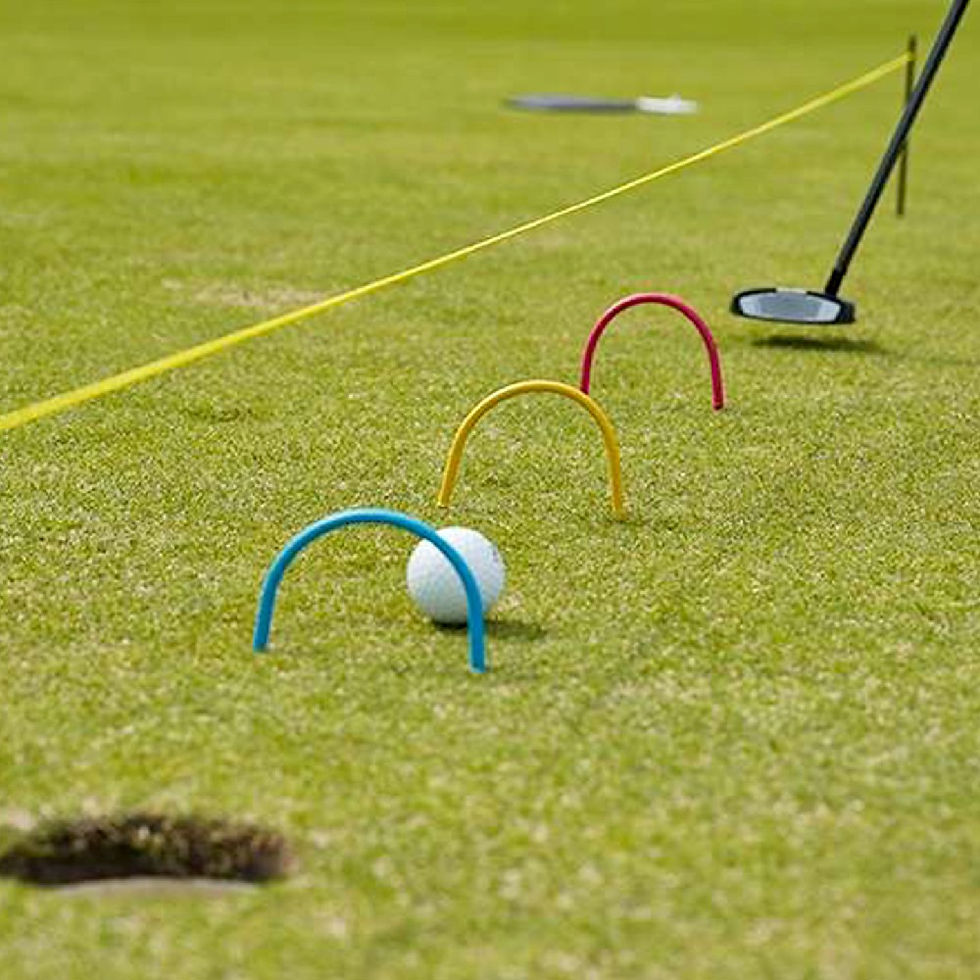
The three openings are 8, 7 and 6 centimetres. Eight is the warm-up and gets your rhythm back. Seven is the one you will live on. Six is where it gets honest, because a ball is 4.27 centimetres across, which leaves you under nine millimetres on each side, and when you can put ten through that one in a row, the putts that used to look makeable start dropping.
It does not explain your miss, but it tells you which way you went. Right leg means the face was open at impact, left leg means closed, and a ball that gets through but drifts means the path was cutting across. Those three mistakes used to be guesses. Now they are answers, one ball at a time.
The kit itself is straightforward. All-black aluminum with a frame only one centimetre wide so it never blocks your line, and it will not bend out of shape or mind damp. Three gates and six bases pull apart into a stack that drops into a golf bag. Either hand works. Bring your own ball and putter.
Start at eight centimetres. Do not rush to the six. That last one will annoy you for a while, and that stretch of being annoyed is where the improvement actually happens.
1. Spikes in the green, bases on your mat, one purchase covers both: tapered legs press into turf and the 2.7 cm bases seat on the gate for indoor use, so you are not buying two sets.
2. Same opening in both modes, so what passes at home passes outdoors: the 7.5 cm body, and the 6/7/8 cm openings, stay consistent across both modes, which makes practice transferable to the course.
3. Three steps from 18.7 mm down to 8.7 mm of margin: eight centimetres to warm up, seven as your daily width, six for accountability, one set carrying you from beginner to competent.
4. Which leg you hit tells you what went wrong: right leg means the face was open, left means closed, and passing through while the ball drifts means the path cut across, with no camera or device needed.
5. Aluminum that will not bend and pulls out in a second: a narrow one centimetre frame that keeps your line clear, no permanent set when a ball clips it, and a set that stacks into a side pocket when you are done.
How to Use (5 steps)
Step 1 - Pick a mode. Indoors on a putting mat, carpet or hardwood, use base mode. Outdoors on a real or practice green, use spike mode. No adapter is needed between the two.
Step 2 - Set up. For base mode, push both legs of each gate into the 2.7 cm round bases and press until seated, giving three gates on six bases. For spike mode, grip the gate at the top of the arch and press both spikes vertically into the turf until the legs stand upright.
Step 3 - Choose a step and position. Start with L at 8 cm to find tempo, move to M at 7 cm for daily work and finish with S at 6 cm for accountability. Stand the gate about 0.3 m, one foot, directly in front of the ball with the opening centred on the target line, and roll putts through the middle without touching a leg.
Step 4 - Diagnose the miss. Clipping the right leg means the face arrived open at impact, clipping the left means closed, and a ball that passes through but drifts means the path was cutting across. Ten balls in a row hitting the same side is the signal to work on grip and wrist.
Step 5 - Combine the drills. Line all three gates up and send the ball through in sequence to check that the whole path is square. Or place three gates in front of the cup and putt through all three before the ball drops, which trains break reading. Or, like croquet, spread the three gates out, send the ball through each in turn until it returns to the start, record the total strokes and beat that record next session.