
SwingPerfect Golf Putting Speed Trap with Rectangular Obstacles. Hit the block: you know instantly, physically, and exactly what went wrong. No video. No coach. No delay. Just the truth at the moment of impact.
- "Set the trap. Swing the stroke. The blocks don't lie."
- "Four configurations. Infinite difficulty levels. One tool that fixes the fault the mirror misses."
- "Speed. Path. Face. The Speed Trap trains all three — simultaneously."
1. Physical Obstacle Feedback — The Fastest Path to Putting Muscle Memory When the putter head contacts an obstacle block, the feedback is instantaneous and unambiguous — no interpretation, no delay, no review required. The body's natural response to unexpected contact triggers immediate proprioceptive correction, building correct stroke patterns faster than any visual or verbal feedback system can.
2. Four Distinct Training Configurations — One Tool Targets Every Putting Fault
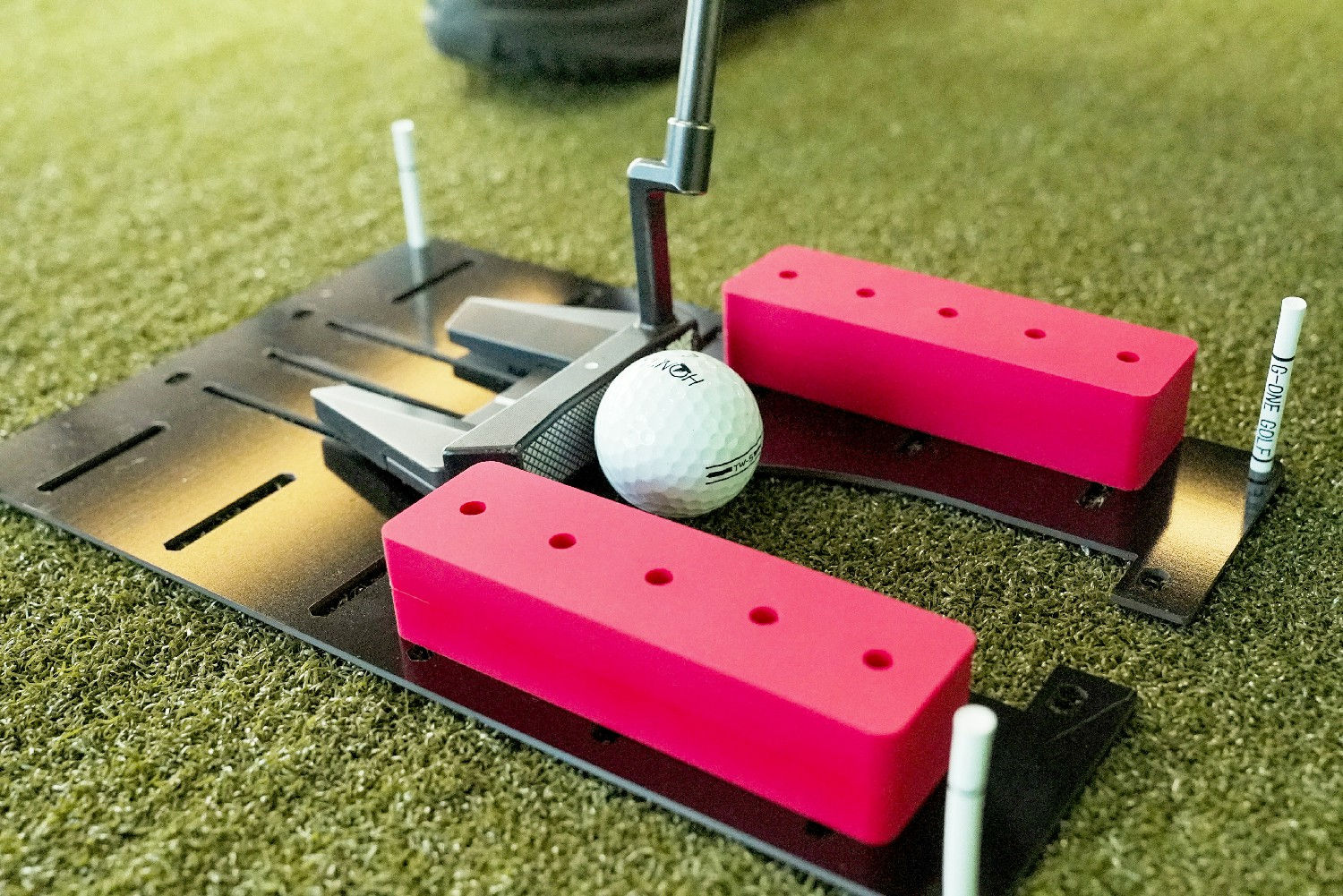
- Configuration 1 (blocks parallel, ball on ground): trains stable putter face through impact and follow-through
- Configuration 2 (blocks behind ball, narrow gate, ball on board): trains peak-speed impact — the putter must accelerate to maximum velocity within half a ball's distance
- Configuration 3 (left-front / right-rear diagonal): trains heel-square backswing + toe-square follow-through
- Configuration 4 (left-rear / right-front diagonal): trains toe-square backswing + heel-square follow-through
3. Two Obstacle Block Shapes — Choose Your Difficulty Level
- Rectangular blocks (12.8 × 3.8 × 2.8 cm · 156g each): can be used flat (wide base, lower tolerance) or on edge (narrower contact zone, higher difficulty). Higher consequence for error — trains the intermediate to advanced golfer.
- Triangular blocks (16 × 3 × 3 cm · 85g each): higher tolerance in flat orientation; flip upright for a narrowed bottom-wide top-narrow channel that increases difficulty progressively.
4. Adjustable Difficulty — Narrow the Gate, Raise the Stakes The distance between obstacle blocks determines the width of the passage. Move them closer together for a tighter channel; move them further apart to build confidence at a lower difficulty. Every configuration is infinitely scalable to the golfer's current skill level — this is not a one-difficulty tool.
5. Carbon Fiber Board — Premium Precision Platform The 30.5 × 19 cm carbon fiber board is precision-engineered with:
- D-shaped cutout for natural putter head entry without edge interference
- Cross-hair ball position markers (ground ball + board ball positions)
- Multiple putter face alignment reference lines
- Precision-slotted ventilation pattern for weight reduction
- Multi-point tee holes for anchoring on grass or artificial turf
- Full independent functionality as a standalone alignment and setup reference board
6. Silicone Blocks — Putter-Safe, High-Visibility, Durable Both block shapes are precision-molded from hard silicone — firm enough to provide clear feedback, soft enough to protect the putter head from damage on contact. The vivid red color creates an unmistakable visual reference that keeps the golfer alert and engaged throughout every practice session.
7. Board + Blocks Work Independently OR Together The carbon fiber board functions as a complete standalone putting reference platform — ball positioning, face alignment, and tee-hole anchoring. The blocks function as standalone obstacle drills without the board. Combine them for the full Speed Trap system. Three tools in two products.
8. Infinitely Personalizable — Design Your Own Drills The four standard configurations are starting points, not limits. Use the multiple tee holes at any position on the board to create custom obstacle layouts targeting your specific putting fault — the Speed Trap adapts to any problem a golfer needs to solve.
9. Premium Leather Case — Protected & Presentation-Ready The complete set ships in a white leather case (33 × 21 cm) — compact, protected, and premium enough for retail display or as a high-end golf gift. The case holds the board and both obstacle blocks securely in one portable package.
10. OEM Ready — MOQ 100 Pieces Available in rectangular block or triangular block version. Custom branding and OEM orders welcome with a minimum of 100 pieces — ideal for golf retailers, teaching professionals, tour vans, and premium gifting programs.
Leather case packaging: 33x21cm, 450g